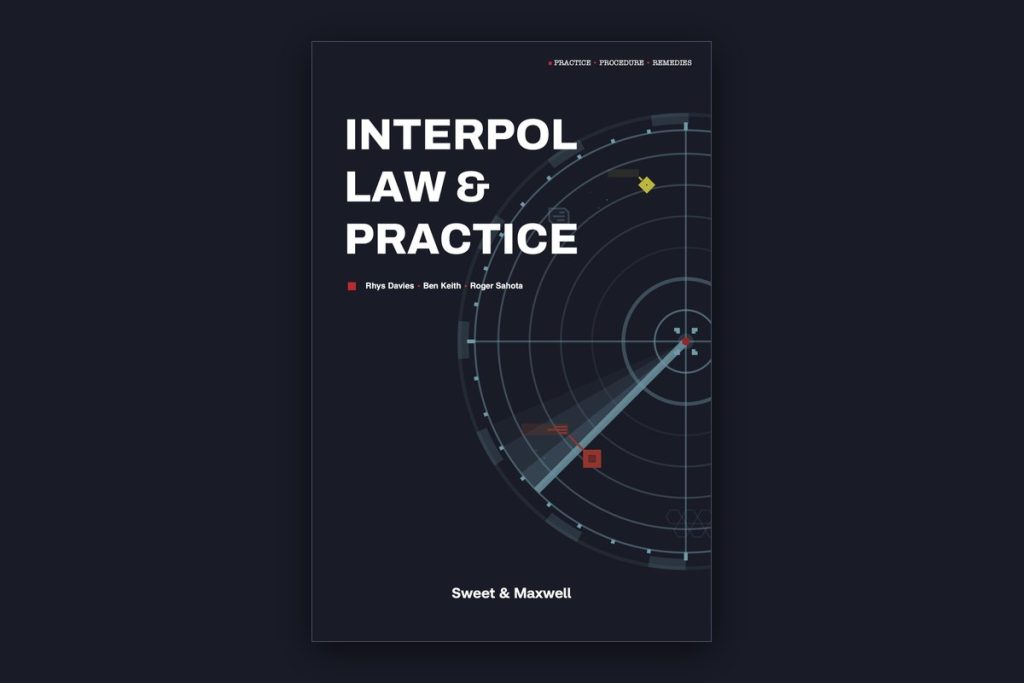
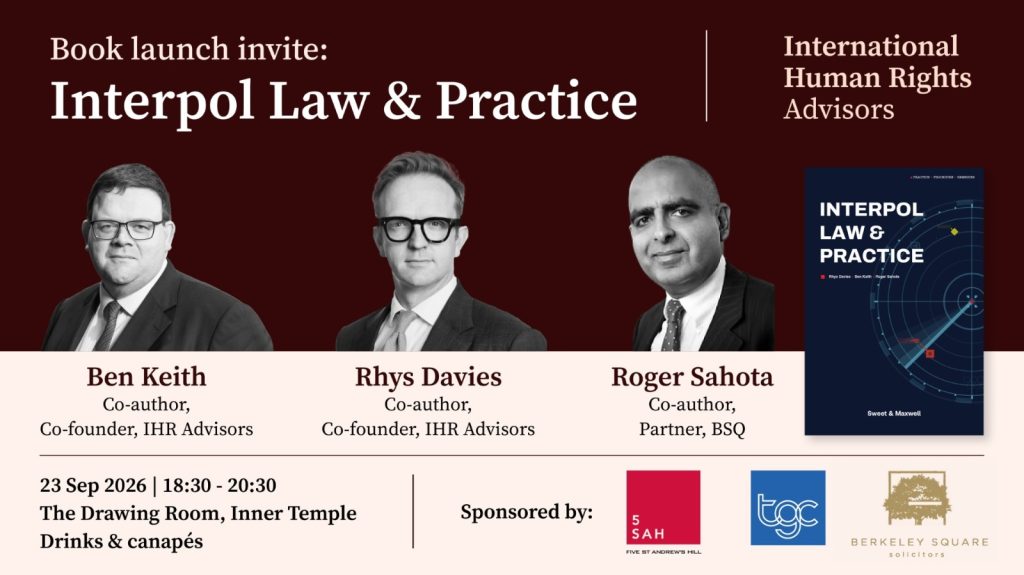
On 23 September 2026, INTERPOL Law and Practice co-authored by Ben Keith and Rhys Davies was launched at the Inner Temple in London. More than 100 people came to mark this lovely occasion. Some of them were lawyers who have spent years challenging Red Notices. Others were people who had spent years living under one.

The guests were a cross-section of the people who deal with INTERPOL from the outside. There were extradition barristers and solicitors, journalists, human rights and immigration practitioners, academics, and representatives of NGOs working on transnational repression.

Our special thanks to Thomson Reuters who ran a stand throughout the evening and sold copies of the book to guests.

Why INTERPOL needed a practitioner's book

INTERPOL law is the set of rules that decides when a member country may use INTERPOL’s channels to seek a person’s arrest, and how that person can challenge it. Those rules are scattered. The starting point is the Constitution, with its ban on political, military, religious and racial activity in Article 3 and its commitment to the Universal Declaration of Human Rights in Article 2. Beneath that sit the Rules on the Processing of Data, the Statute of the Commission for the Control of INTERPOL’s Files, the CCF’s own decisions (published only in summary form), and a growing body of national extradition judgments.

A lawyer coming to the subject for the first time has no single place to find all of that. Nor is the written law the whole picture. The CCF’s Statute gives it nine months to decide a deletion request once it is admissible. We have had cases take almost two years, with the client arrested at borders in the meantime. What matters in practice is knowing where the formal rules end and how the institution actually behaves.

What the book covers

INTERPOL Law and Practice follows the life of a notice. It starts with the request from a National Central Bureau and moves through review by the Notices and Diffusions Task Force and publication. It then covers the remedies: pre-emptive submissions, access requests, deletion applications and interim measures before the CCF. It also deals with diffusions, which bypass much of that front-end scrutiny, and with what a notice does to extradition, immigration, asylum and banking decisions once it is on the system. [Check this against the contents page and add any chapter worth naming.]

Readers of this site will recognise much of it. The book grew out of the casework behind Red Notice Monitor and our earlier report, Undue Influence: The UAE and Interpol. It also draws on the long run of posts here about abuse of the system by Russia, China, Türkiye, the UAE and others.

Why it matters for people at risk

People named in a Red Notice rarely choose their lawyer on the basis of INTERPOL experience, because until they are arrested most have never heard of the CCF. The first adviser they reach is often an immigration solicitor, a criminal practitioner in another field, or a bank’s compliance team. Getting the law into print gives all of them something to work from. The person facing the notice is better off as a result.

INTERPOL’s safeguards have improved over the last decade, and some of that change came from outside pressure. Pressure works better when the rules are written down in one place and can be quoted back to the institution.

Our thanks go to the Inner Temple for hosting us, to Thomson Reuters for publishing the book and running the stand, and to everyone who came. INTERPOL Law and Practice is available from Sweet & Maxwell. Anyone affected by a notice can find out how to remove a Red Notice, or contact us in confidence.

About the Authors

Ben Keith Barrister

Ben Keith is an award-winning barrister specialising in International Criminal law and International Human Rights law. He is an expert on Interpol and the red notice system and subsequent extradition and asylum proceeding.

View Ben Keith's profile
Rhys Davies Barrister

Rhys Davies is an award-winning barrister and is a specialist in International Criminal law and International Human Rights law. He is an expert on Interpol and the red notice system. Rhys has extensive experience of advising clients detained at the behest of repressive regimes.

View Rhys Davies's profile