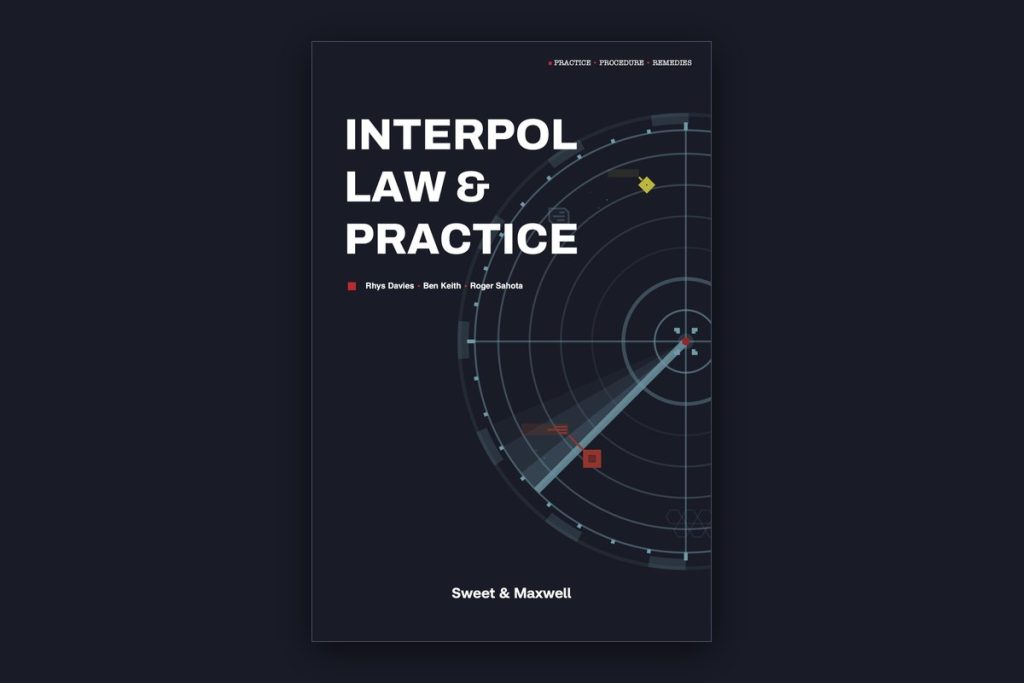
Every application to remove an INTERPOL Red Notice comes down to one question: which of INTERPOL’s rules has the requesting state breached? Chapter 5 of INTERPOL Law and Practice, published by Thomson Reuters on 23 September 2026, covers the substantive arguments for challenging a Red Notice or Diffusion before the Commission for the Control of INTERPOL’s Files (CCF). It also covers the order in which to use them.
Why will the CCF not hear that you are innocent?
The CCF does not try cases or decide guilt. It asks whether the data complies with INTERPOL’s own rules. Someone who has just discovered a Red Notice usually wants to tell INTERPOL they are innocent, and that is the one argument the Commission will not hear.
Four arguments do almost all the work. Article 3 of INTERPOL’s Constitution bars the organisation from matters of a political, military, religious or racial character. Article 2 binds it to the Universal Declaration of Human Rights. Article 82 of the Rules on the Processing of Data (RPD) requires a Red Notice to serve a real enforcement purpose. And Article 83 of the RPD rules out Red Notices for certain offences altogether, among them private disputes, family matters and offences that turn on cultural or behavioural norms. Most successful applications combine two or more.
How do you show the politics behind a fraud charge?
No state describes its own notices as political. The indictment says embezzlement or tax fraud, and on its face the CCF sees an ordinary crime. The answer is the predominance test in RPD Article 34(3), which weighs seven factors:
- the nature of the offence and the facts beneath it
- the status of the person
- the source of the data
- the position of other National Central Bureaus (NCBs) or international bodies
- obligations under international law
- the risk to INTERPOL’s neutrality
- the general context
None of these outranks the others. The context factor is the gateway for everything the indictment leaves out.
What goes through that gateway must be specific. Press reporting counts, as does witness evidence from other politicians or proof of the person’s connections. A bare assertion of political motive does not. Without supporting material, the CCF has said, it would be forced to judge credibility, and that is a job for a trial court.
The chapter shows the CCF finding political motivation against people who held no office at all. In some cases this rested on family ties to a former president, or on membership of the opposition, or on association with a serving politician. In fraud and corruption cases, which are what most applicants face, the decisive question is personal benefit. If the requesting state cannot show what the person gained, its notice is in trouble.
When does human rights evidence land?
INTERPOL reads Article 2 narrowly. A bundle of country reports describing a flawed justice system rarely moves the CCF. What lands is evidence of concrete violations against the applicant or people close to them, such as fabricated evidence or confessions under duress. Human rights arguments rarely win alone. They work best alongside Article 3, filed once the notice has had real consequences.
What if the state knows where you are and has done nothing?
A Red Notice exists to locate someone and secure their extradition. Sometimes the state knows where the person lives and has made no extradition request. In that case the notice has become a substitute for law enforcement, and the CCF has deleted notices on that basis. Under RPD Article 81(d), the General Secretariat must cancel a notice where the NCB could seek extradition, takes no steps and cannot explain why.
What does a winning application look like?
A businesswoman was charged with issuing false VAT invoices. She had never held political office, but she chaired a company linked to a politician known for speaking out on human rights. Her application to the CCF was built around that link.
It made three points. The company said to have benefited from the invoices had never been convicted. Other companies allegedly involved had either never been prosecuted or had seen their charges withdrawn. And the UN Committee against Torture, Human Rights Watch and Amnesty International had all reported on political prosecutions in the country.
The CCF did not decide whether she was guilty. It sent the matter back to the requesting NCB with specific questions about her personal role and her benefit, including how the profits had been calculated. The NCB never answered. The Commission recorded that ‘despite extended deadlines and several messages, it received no specific answer’, and ruled the data non-compliant with INTERPOL’s legal framework.
The CCF will not hear that you are innocent. It will hear that the requesting state has broken INTERPOL’s rules, if you show it how.
How IHR Advisors can help
We act for people facing Red Notices and Diffusions, from the moment they discover the notice through CCF applications and requests for deletion. Where a case raises wider human rights questions, we also draw on our international law practice.
This article draws on Chapter 5 of INTERPOL Law and Practice by Ben Keith and Rhys Davies, published by Thomson Reuters on 23 September 2026. Order from Sweet & Maxwell.
If you believe a Red Notice or Diffusion against you is political or serves no legitimate purpose, contact us in confidence.