INTERPOL is publishing Red Notices faster than at any point in its history, and the Commission for the Control of INTERPOL’s Files (CCF), the body that hears challenges to them, is missing its own deadlines. INTERPOL still will not say which countries request the most notices, or whose notices are removed most often.
INTERPOL’s General Assembly meets in Hong Kong from 30 November to 3 December. These are the figures we think delegates, practitioners and civil society should have in front of them before the session opens. For background on how the notice system works, see our guide to INTERPOL explained.
Red Notices are up 60 per cent in two years
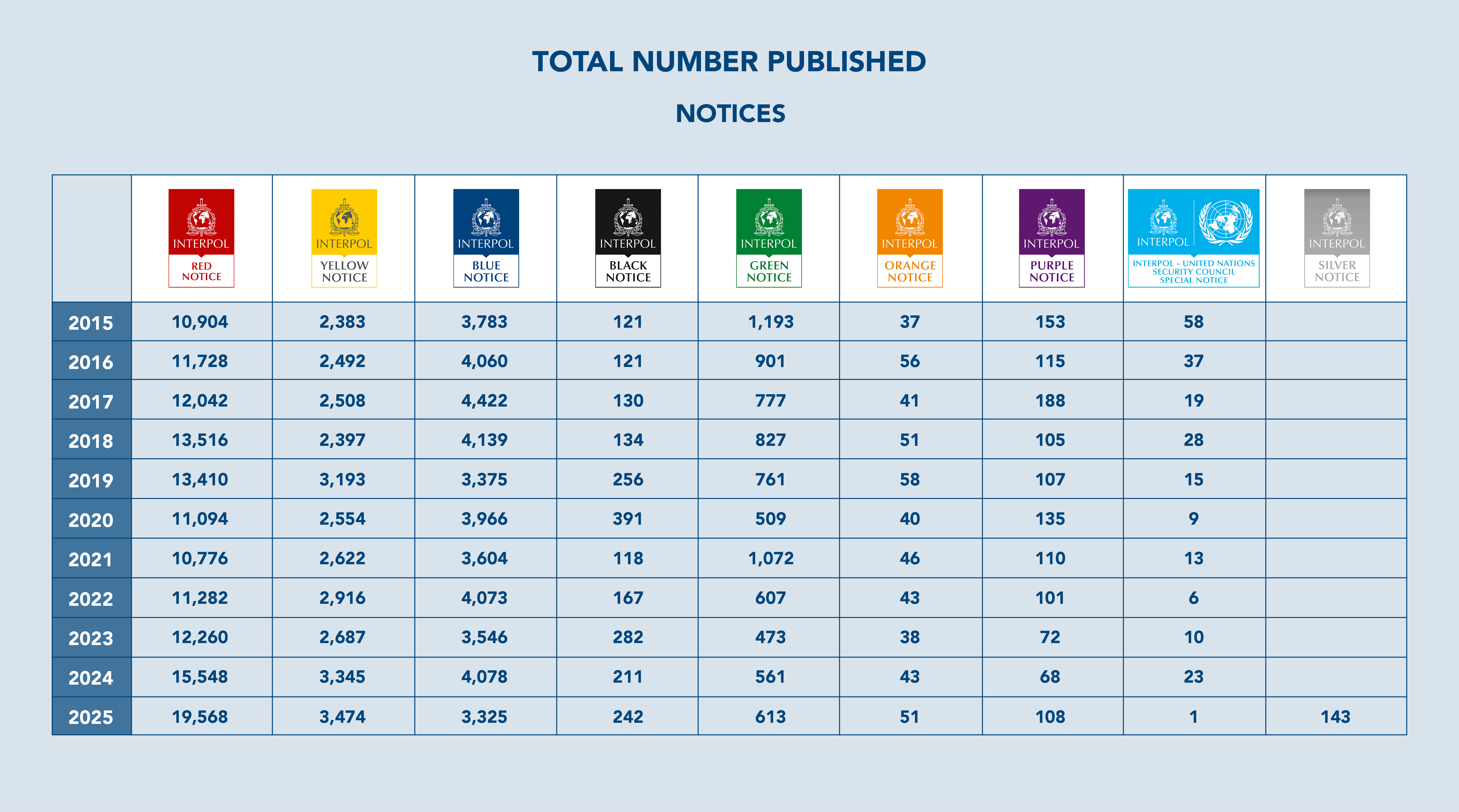
INTERPOL published 19,568 Red Notices in 2025, up from 15,548 in 2024 and 12,260 in 2023. That is a rise of about 60 per cent in two years, and INTERPOL has offered no explanation. Its statistics count notices published rather than notices requested. Nobody outside the organisation can tell whether states are asking for more or the General Secretariat is refusing fewer.
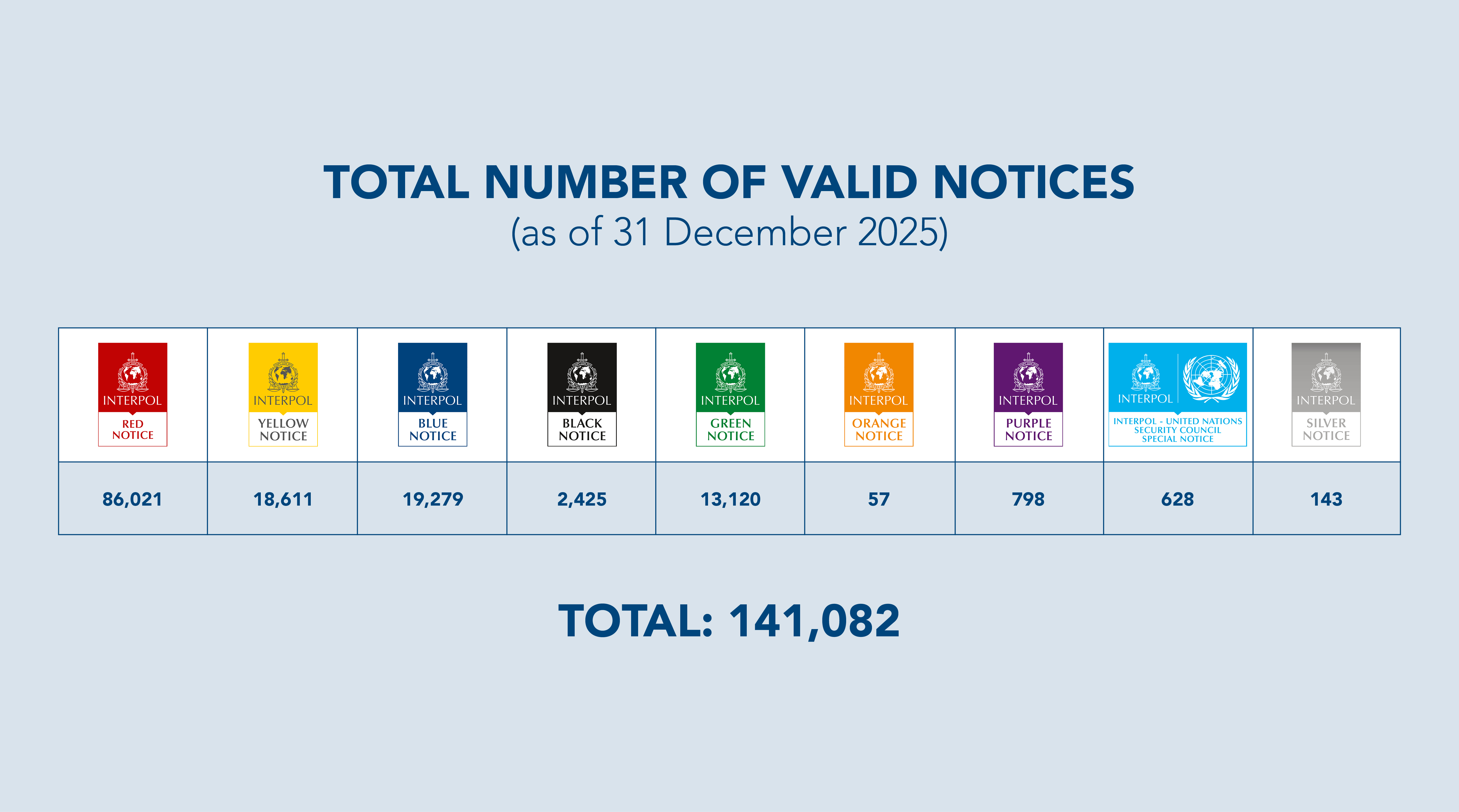
The long view is starker. On 31 December 2025 there were 86,021 valid Red Notices and 141,082 valid notices of all types. INTERPOL’s 2011 annual report records 1,418 Red Notices issued in 2001, a year in which 10,131 notices of every type were in circulation. INTERPOL now publishes more Red Notices in an average month than it did in the whole of 2001.
How many Red Notices did INTERPOL refuse in 2025?
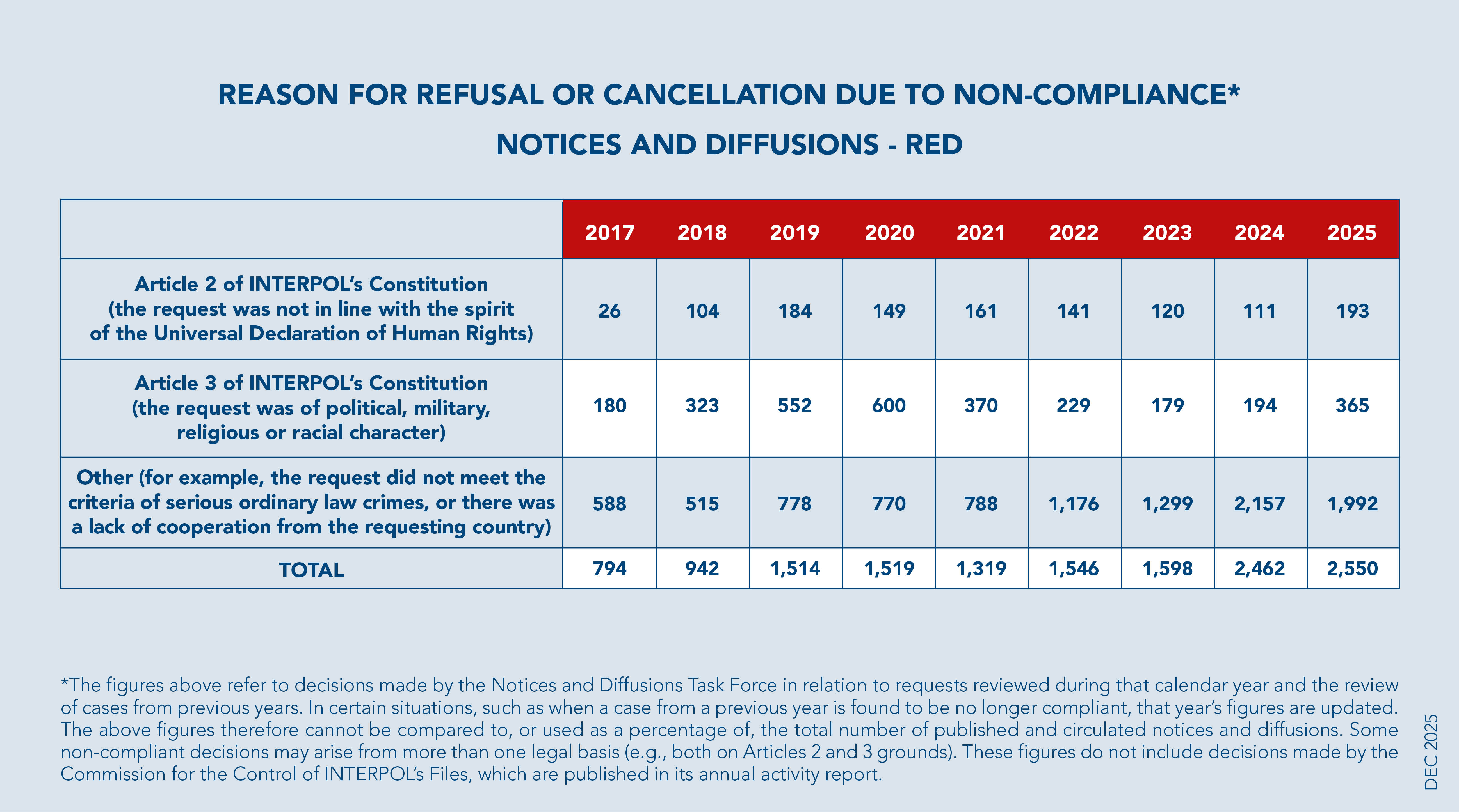
The General Secretariat refused or cancelled 2,550 Red Notices and wanted person diffusions as non-compliant in 2025, according to INTERPOL’s table for the year. Of those, 193 fell under Article 2 of INTERPOL’s Constitution, which requires the organisation to act in the spirit of the Universal Declaration of Human Rights. Another 365 fell under Article 3, which prohibits any intervention in matters of a political, military, religious or racial character.
The CCF is busier, and slower
The CCF received 2,793 requests in 2023, 70 per cent more than in 2021. Of those, 1,101 were for access, 1,021 for correction or deletion, 557 for revision of an earlier decision and 114 of other kinds. When the Commission rules on a complaint, it finds the data non-compliant roughly half the time. In an earlier post we calculated the average annual rate of non-compliance findings between 2012 and 2023 at 50.8 per cent.
The CCF Statute gives the Commission four months to answer an access request and nine months to decide a request for deletion. In each case time runs from the date the request is declared admissible, and the Commission may extend it where the circumstances of a case warrant. In 2023 it missed those deadlines in about 30 per cent of access requests and 15 per cent of complaints. Its report for 2024 puts the figures at 70 per cent and 30 per cent. No later figures have been published. For anyone trying to remove a Red Notice, the delay matters, because the notice ordinarily stays in place while the Commission deliberates.
Which countries request the most Red Notices?
None of these statistics is broken down by requesting country. They do not show which states obtained the 19,568 notices published last year, or whose requests produced the 558 decisions under Articles 2 and 3. In 2025 INTERPOL told the Joint Committee on Human Rights at Westminster that no single country predominates in the use of Red Notices. Nobody outside the organisation can test that claim. Public reporting has repeatedly named China, Russia and Turkey as among the most persistent abusers of the system.
What the General Assembly should ask for
If the General Assembly is to judge whether INTERPOL’s safeguards can cope with this volume, it needs at least two more figures: how many notices were cancelled after publication, as distinct from refused before it, and which countries’ requests were refused. Both sit in INTERPOL’s own records. Member countries should ask for them, and INTERPOL should publish the answers. Until it does, the states abusing the system can rely on nobody being able to prove it.